
PRELIMINARY REPORT
The expedition was in the field between 19th April and 12th May 2019. The group was based at Park HQ in the Research Centre. The principal aims were:
• to attempt to connect the Cave of the Winds, Racer/Easter cave system, and Lagang’s Cave.
• to investigate the Northern ends of Clearwater at the connection to Blackrock, and Edwin’s Long Cut.
• to investigate climbs in Sarawak Chamber
• to perform microbiological fieldwork at sites of interest.
The team consisted of fifteen members, including two from the USA and one from Germany. A further member joined from the Sarawak Forestry Corporation, and support was provided by a local operator and local boatmen.
Cave of the Winds has been explicitly shown to connect to Racer Cave through a sump, confirmed by shining lights between the two ends. This has not been passed by a human as it appears to be a fairly awkward sump so will require a short dive to complete the first through trip.
Easter and Lagangs caves were not connected, but extensions to both have taken them even nearer to each other. Extensions to Easter now provide an additional entrance between the two Lagangs entrances, whilst extensions to Lagangs have given a new entrance in a doline likely to be the same as the Easter South entrance.
A provisional total of 3260 metres of new passage was found. This is split into 939m in Clearwater, 1043 m in Lagangs and 1130 m in Racer/Easter. Some minor caves were also discovered and extended.
COTW AND RACER
In Cave of the Winds leads in Eureka chamber were first ticked off. Three climbs were completed, and all three terminated in calcite/mud chokes close to the current limit of the cave. These passages are marked in red in the following cave centreline elevation plot.
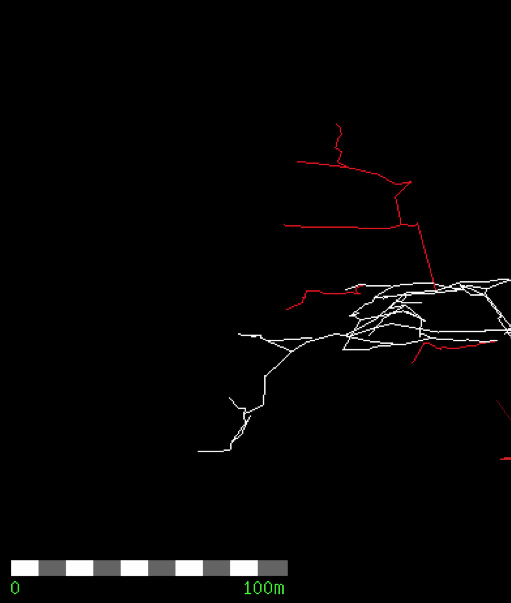
Given that all of these levels terminate in calcite it is thought unlikely that there will be passable passage apart from the terminal sump (the lowest point in Figure 1).
The sumps on both the Cave of the Winds and Racer sides were investigated further. Strong radio connection could be achieved, and parties could hear bolt drilling through the rock. The direction of flow between the sumps was established by muddying the water from the upstream side in Racer, and this was identified to connect with the left hand sump branch downstream. This was later confirmed by putting a light in the downstream sump which could be seen at the upstream end.
Investigation in Racer gave new passage in an area called the Boneyard. This extends in the direction of the COTW streamway, but terminates a long way short. Mushroom Chamber and the Mezzanine level of Racer were also pushed but yielded no significant extension. These both terminate in massive calcite chokes.
LAGANGS AND RACER/EASTER
The Fast Lane area of Lagangs was thoroughly investigated. Anniversary Passage was pushed to the surface somewhere between the Lagangs entrance and Easter South entrance. Areas close to the Fast Lane entrance were surveyed adding passage, entrances and helping fill the gap between the Fast Lane and Main Lagangs entrance.
Further upstream in Lagangs, Balcony Passage was reinvestigated as it climbs high above the Lagangs level towards Racer. There were no continuations found.

In Easter two leads were pushed at the south western end in Road To Lagangs. Express Elevator was descended and pushed on two trips, the second of which followed the passage all the way out of the cliff. This gives a new Easter entrance between the Fast Lane and Main Lagangs entrance – but unfortunately still no connection.
NORTH CLEARWATER
A camp was established in Revival in Northern Clearwater to aid access to the further reaches. From here a team investigated the Dune series and East passage to find new, strongly draughting passage. Both were difficult to push due to the need to aid climb.
In the Dune series a draughting ramp was followed down to the East for 60m. This then turned into a steep climb which gains 90 metres of height. This was left at a climb which requires more tackle.
In East Passage an inlet was followed and a draughting rift entered. This was followed down through a muddy chamber before crossing a small pool of water and rising into a large chamber which was named Hypothesis. A strongly draughting strike passage was followed North East for 100m before a climb across a steep muddy slab halted progress.
Due to time constraints, and the ongoing leads in Clearwater there was no trip to investigate Edwin’s Long Cut. This is still of interest, but will have to wait for future expeditions.
SARAWAK CHAMBER
A team camped in Sarawak Chamber to climb the previously identified leads. A climb in the West wall was attempted however before completion the cave was hit by a flood pulse. Water from the ceiling prevented any further climbing. The team was able to exit the following morning once the stream level had returned to normal.
MICROBIOLOGY FIELDWORK
The science brief was to cover as many areas of the Mulu caves as easily practical looking for microbiological features. These included:
1. Phytokarst near cave entrances – these typically look like spikes of rock pointing towards the sunlight.
2. Phytogens – bent soft stalactites at cave entrances; often associated with tree roots.
3. Moonmilk – soft material covering sections of wall, of which there may be several different types.
4. Bacteria colonies – effects that are seen on rock due to organic rich inflows of water.
5. Wall flutes caused by swiftlet nests and the associated microbiology.
Samples were taken in accordance to the permit. These have been taken to laboratories for further analysis.
TEAM MEMBERS
• Rambli Ahmed (from Sarawak Forestry)
• Hazel Barton (from USA / cave microbiologist)
• Derek Bristol (from USA)
• Judith Calford
• Dave Cooke
• Andy Eavis (Joint Leader)
• Chris Howes
• Ben Kent (Joint Leader)
• Tim Kent
• Elaine Oliver
• Carsten Peter (from Germany)
• Tony Radmall
• Alistair Smith
• Frank Tully
• Les Williams
• Chris Williams
The team was supported by:
• Veno Enar (local logistics)
• Jimmy (boatman / porter)
• Wilson Julie (boatman)
• Steve Lian. (porter)
ACKNOWLEDGEMENTS
The expedition is grateful for the support it has received, including the following:
• Malaysian Airline Systems.
• Expedition Foods
• Ghar Parau Foundation
• Gunung Mulu National Park, especially Hein Gerstner (Park Manager)
• Lyon Equipment
• Mount Everest Foundation
• Sarawak Forestry Corporation
• Spanset
• Starless River
• Dick Willis
• Lilian Eavis
• Ben Lyon
• Tony Waltham
• Nick Williams
• All previous Mulu expeditions and, in particular, those individuals who have been instrumental in developing and maintaining the Mulu survey database, particularly Matt Kirby and Tim Allen.